
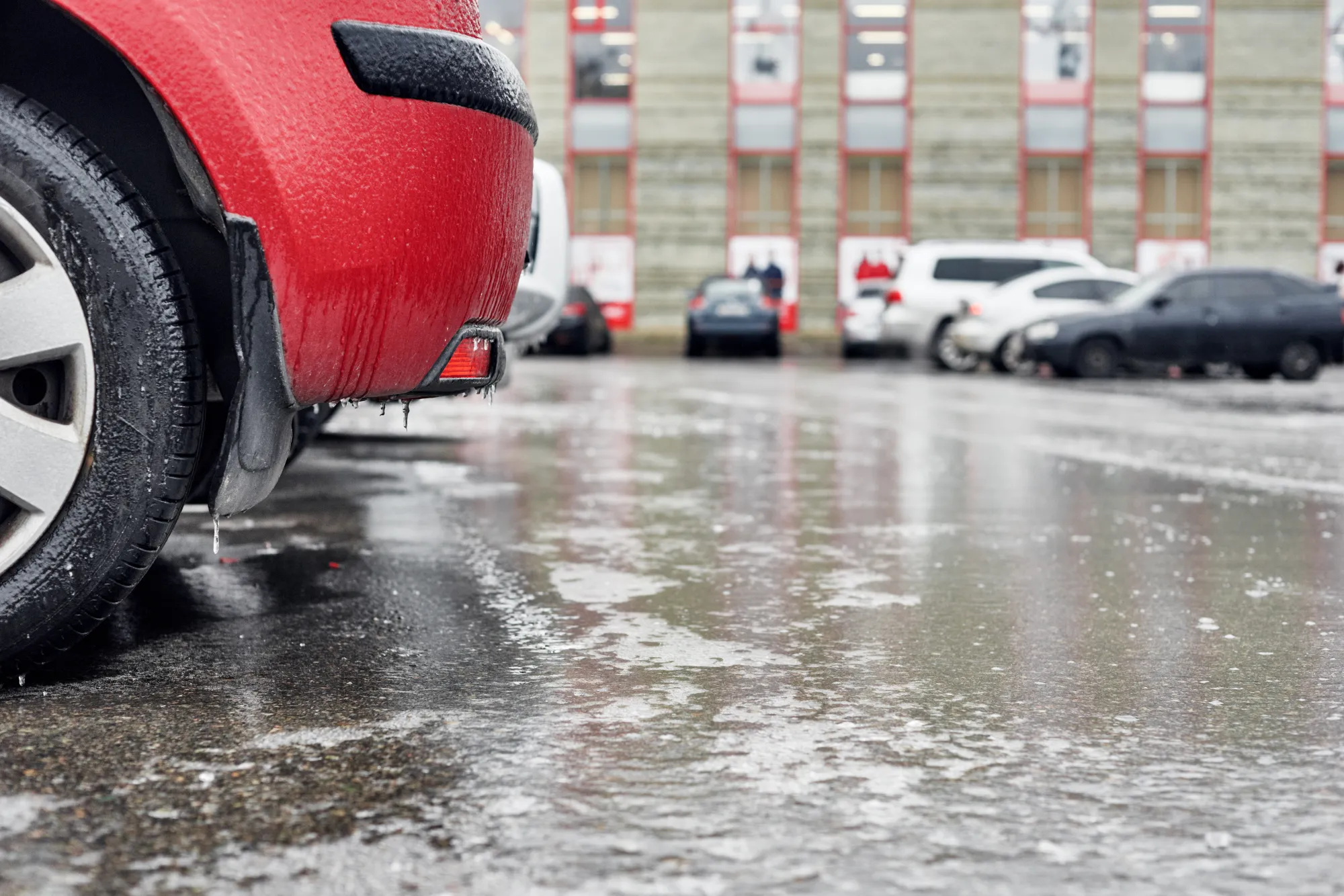
Every November we get the same question at the counter, and it is a good one: do I need snow tires, or are my all-seasons fine? The honest answer is that the question is aimed at the wrong thing. “All-season” and “winter” are names on a box. What decides whether your car stops at the end of your street in Madison is how the tire is built.
Three things do the work: the rubber compound, the siping, and the tread depth. Once you know what each one is for, you can look at two tires and tell which one is going to help you in a lake-effect band off Lake Erie and which one is mostly going to help you in a showroom.
There is a second wrinkle. A winter here is not one kind of driving. Backing out of an unplowed driveway onto a township road in North Madison at 6:30 in the morning asks a tire for one thing. Running I-90 toward Painesville at highway speed on pavement the plows have already been over asks it for something completely different. Sorting that out is most of the decision.
Why “All-Season” Is a Marketing Word, Not a Build Spec
Nothing about the phrase “all-season” is measured, certified, or tested. It describes an intention. The tire is meant to be acceptable in a lot of conditions, which in practice means it is optimized for none of them.
That compromise is fine in a lot of the country. It is a harder sell in Madison, Geneva and Perry. Lake, Geauga, eastern Cuyahoga and Ashtabula counties make up Northeast Ohio’s primary snow belt, and the totals inside that belt are not subtle. Geauga County towns like Chardon and Hambden often clear 120 inches a year, against roughly 70 inches a season in Cleveland and about 48 in Akron. We sit in the part of the map where a compromise tire spends several months being asked for more than it was designed to give.
No two winters here are the same, either. The National Weather Service in Cleveland recorded the 2023-24 season finishing at least 30 to 40 inches below normal across northern Ohio, with the snowbelt counties running over 70 inches below normal and Cleveland measuring just 25.7 inches. You buy tires for the winter that shows up, not the one you hope for.
So instead of shopping by season name, shop by the three build details underneath it.
What the Rubber Compound Does Below 45 Degrees
This is the part nobody can see, and it matters the most.
Rubber gets stiffer as it gets colder. An all-season compound is mixed to hold up through a hot Ohio July, which means that by the time the thermometer drops it has already started to firm up. AAA recommends winter tires anywhere average temperatures fall below 45 degrees Fahrenheit, for exactly this reason: winter tread stays flexible as temperatures fall past that mark, and all-season tread does not.
Why does flexibility matter? Grip is a tire conforming to the surface it is on. A pliable tread block settles into the texture of cold pavement and into the loose granular structure of snow. A stiff one skates across the top of it. Same tread pattern, same tread depth, completely different result.
The important part is that this happens on bare pavement too, not just on snow. A cold, dry January morning on Route 20 with no snow in sight is still a cold-rubber problem. AAA points to Tire Rack testing that found a 35% improvement in braking with winter tires compared with standard all-seasons. That is not a small margin.
If you have already read our post on why all-wheel drive gets you moving but does not help you stop, this is the same idea one layer down. Stopping is a tire job, and below 45 degrees the compound is doing most of that job.
Siping and Biting Edges: What They Buy on an Unplowed Side Road
Look closely at a winter tire and you will see the tread blocks are cut through with fine slits. Those are sipes, and they typically run between 0.015 and 0.030 inches wide, cutting partway down into the block.
They are not drainage grooves. As the tire rolls and the block squats under the car’s weight, each slit opens slightly and turns one flat rubber face into two sharp edges that bite. Multiply that by a full tread and you get thousands of gripping edges instead of a handful of block corners. Winter tires carry the highest concentration of siping of anything sold. All-season tires use a moderate amount, because heavy siping costs something in dry handling.
Here is where that becomes a Lake County question rather than a general one. Sipes earn their keep at low speed on loose, unpacked snow, which is precisely the surface between your garage and the nearest cleared road.
The Lake County Engineer’s Office is straightforward about the order of work during a storm: SR 2 first, then county roads, then any township, village or city roads it is helping with. It runs roughly ten plow trucks on the county road system and four on SR 2, covering over 304 lane miles of county road and 110 lane miles of SR 2. On the county highways, crews concentrate salt on hills, bends and intersections and spot-treat the straight stretches to keep them passable while the storm is still going.
Read that as a driver. The first mile of your morning is the least likely mile to have been plowed, and it is the mile where you have the least speed and the most starting, turning and stopping to do. That is a biting-edge problem, and it is the mile most tire shopping ignores.
M+S vs the 3PMSF Snowflake: What the Sidewall Actually Promises
Two markings show up on sidewalls around here, and they are not equivalent.
M+S stands for mud and snow. It is assigned by the manufacturer based on the geometry of the tread pattern. Pirelli, quoted in the trade press, called it “a more generic indicator which does not have any specific performance tests it has to pass.” Nothing was measured. Nothing was driven.
3PMSF, the three-peak mountain snowflake, is different. The U.S. Tire Manufacturers Association set up the qualifying tests in 1999, and a tire has to earn the symbol on a real test. Under the ASTM F1805 procedure, the tire must reach a traction performance index of 110 or better against a standard reference test tire rated 100. A tire either clears that or it does not wear the snowflake.
Now the part most articles leave out.
That test measures one thing: driving traction in a straight line on a snow-covered surface. It does not measure braking. It does not measure cornering. It does not measure ice, wet, or slush. Les Schwab states plainly that 3PMSF tires are not tested for braking and cornering on ice. Manufacturers themselves, quoted in Modern Tire Dealer, list the same gaps.
So the snowflake is a floor, not a grade. The spread above that floor is enormous: dedicated winter tires typically test between 130% and 150% of the reference tire, while an all-season can carry the symbol having barely cleared the minimum. Both sidewalls show the identical symbol. They are not the same tire.
- No marking at all: a summer or performance tire. Not a snowbelt tire.
- M+S only: a claim about tread shape. No test behind it.
- 3PMSF on an all-season: it passed a minimum straight-line snow test. Better than M+S alone, and a real option for some drivers.
- 3PMSF on a dedicated winter tire: same symbol, far higher score, plus the compound and siping that the test never looks at.
The Squall Band vs the I-90 Run: Two Jobs for Snow Tires in Lake County, Ohio
Picture one Madison driver on one morning.
6:30 a.m., a side street off North Ridge Road. A lake-effect band came through overnight. Two inches of wind-blown snow sit on a cold surface, nothing has been plowed yet, and the drive is all low speed: pull out, creep to the stop sign, turn, stop again. Nothing here is about top speed. It is about whether the tread can find something to hold. That is a compound question and a biting-edge question, with tread depth deciding how much snow the tire can pack and shed before it just rides on top of it.
6:50 a.m., merging onto I-90. Different world. The interstate has been plowed and salted, the pavement is bare, wet and cold, and traffic is moving at highway speed. Loose snow is no longer the enemy. The hazards are cold-pavement grip, slush lying along the lane lines waiting to pull at the steering, and the squall itself.
Snow squalls deserve their own respect. They are brief, usually under an hour, and they can drop visibility to a whiteout within minutes. When a band crosses I-90 between Madison and Geneva, stopping distance matters more than usual.
Sort the two drives by what they ask for:
- Squall band, unplowed side road: flexible compound, dense siping, generous tread depth. Low-speed traction and short stops. A dedicated winter tire is built for this exact mile.
- Cleared I-90 run: cold-weather grip on bare pavement, slush evacuation and stability at speed. A quality all-season with 3PMSF handles a lot of this. A winter tire still stops shorter when it matters.
Most people here drive both, which is why the answer is usually a dedicated winter setup rather than a compromise. The winter tire is strong in the mile the all-season is weakest in, and still competent in the mile the all-season is best in.
Choosing Winter Tires in Madison, OH by the Way You Actually Drive
Forget the season label and answer these instead.
- How does your street get cleared? If you are on a township road that gets attention after SR 2 and the county roads, you are the squall-band driver. Weight the decision toward dedicated winter tires.
- How much of your winter is highway? Mostly cleared I-90 and Route 20, garage-kept, and you can stay home when it is bad? A well-chosen all-season carrying 3PMSF is a reasonable call.
- What are you driving? Front-drive, rear-drive and all-wheel drive all stop through the same four contact patches, and every one of them is helped by better rubber.
- How much tread is left? A winter tire with the depth worn out of it stops behaving like a winter tire. Our guide on how to measure tire tread depth at home walks through the check in a couple of minutes.
- How old are the tires? Compound hardens with age whatever the tread looks like, which is why we wrote how to tell the age of your tires.
Buy four. A winter tire on one axle and an all-season on the other gives the car two different grip levels front and rear, which makes it less predictable in a corner. Matched sets are the safer choice.
If you are considering studs, Ohio sets the calendar. Under state law, studded tires may only be run from November 1 through April 15 of the following year. That window is a useful frame for a seasonal changeover even if you never go near a stud.
Talk to a Local Tire Shop in Madison, OH Before the First Band Rolls In
There is no single right answer on snow tires in Lake County, Ohio. There is a right tire for your street, your commute, your vehicle and the way you drive when the visibility drops, and picking it takes a five-minute conversation, not a spec sheet.
If you are searching for a tire shop near you in Madison this fall, start with the conversation rather than the catalog. We have been Madison’s trusted auto care experts since 1990, and we serve drivers across Madison, North Madison, Geneva, Perry and Painesville. We would rather talk it through with you in October than mount something in a hurry in January. Bring the car in, tell us where you live and what your morning looks like, and we will show you what the tread and the sidewall on your current tires are telling us. When you are ready to shop for tires, we will match the build to your street rather than to the season on the label. If you want numbers on a set of winter tires in Madison, OH, request a current quote and we will price your exact size and options as they stand today.


