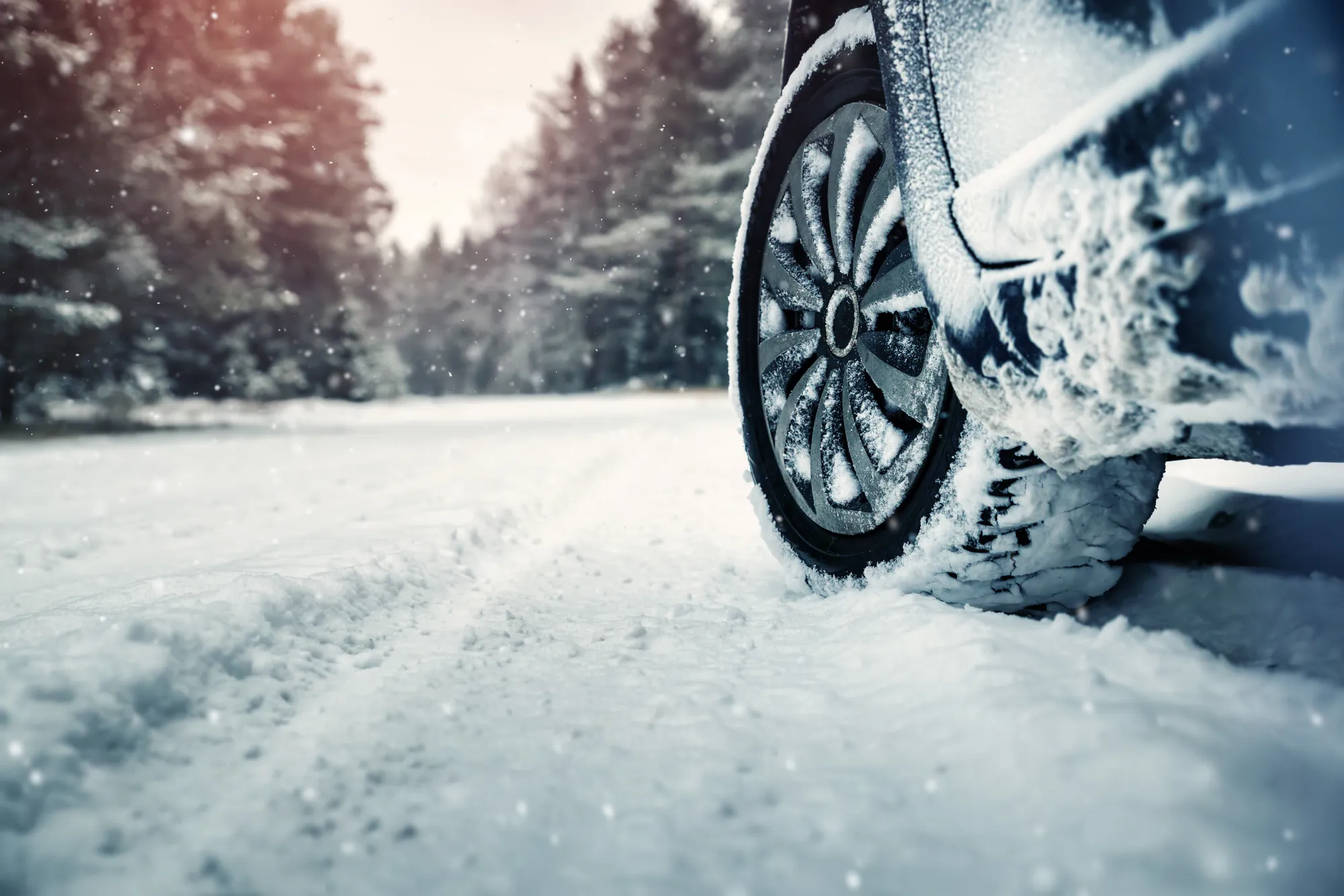
There is a moment every Madison driver knows. Six inches of fresh lake-effect snow came down overnight, you back the all-wheel-drive crossover out of the driveway, it pulls away without a single wheel spinning, and you think: this thing is unstoppable.
That feeling is where the trouble starts.
All-wheel drive is genuinely useful. It gets you out of the driveway, up the hill, and off the line at a light when the road is covered. But the drivetrain has nothing to do with slowing down or turning. When you reach the end of your street and press the brake pedal to turn onto North Ridge Road, the engine is not pushing any wheel. Every bit of grip you have left comes from four patches of rubber roughly the size of your hand, and from the brake hardware behind each wheel.
That gap is the whole story of AWD winter driving in Madison, OH. We have been fixing cars at 5445 N Ridge Rd since 1990, and this is the winter conversation we have most often. A driver comes in from Madison, North Madison, Geneva or Perry sure something is wrong with the vehicle, because it goes fine and it just does not stop. Usually nothing is wrong with the drivetrain. The tires and the brakes are telling the truth.
What AWD Actually Does, and Where It Quits
All-wheel drive divides engine torque among more wheels. Instead of asking two contact patches to do all the pushing, it asks four. On a slick surface, where each tire can only take a little torque before it slips, spreading the load is a real advantage. That is why the AWD vehicle leaves the driveway while the neighbor’s front-wheel-drive sedan sits there spinning.
Braking is a different physical problem. Under braking, none of the wheels are driven. The University of Michigan’s Sustainable Worldwide Transportation program put it about as plainly as it can be put in its 2016 report on winter tires: four-wheel-drive and two-wheel-drive vehicles fitted with the same tires perform similarly during braking and cornering on slippery roads, because under braking the number of driven wheels becomes irrelevant.
Michelin puts it plainly too. AWD helps with acceleration but not with braking or turning. Bridgestone sees almost no difference between AWD-equipped vehicles and ordinary cars in cornering, braking and handling in winter weather, for one simple reason. All of the vehicle’s traction comes from the tires.
So AWD multiplies what you can do with the grip available. It does not create grip. And it contributes nothing to the two things that keep you out of a ditch, which are stopping and steering.
Why Confident AWD Drivers End Up in Snowbelt Ditches
Here is the uncomfortable part. The University of Michigan report argues that four-wheel drive can actually raise a driver’s risk, and the mechanism is psychological rather than mechanical. Because the vehicle accelerates so well in low-grip conditions, the driver reads that as evidence the road is grippier than it really is. The report calls it a false sense of confidence concerning road friction, and says it could explain why a disproportionate number of four-wheel-drive vehicles and SUVs end up in the ditch during early-season storms.
The risk is a speed that feels fine right up until the driver needs to stop.
The report’s headline finding is worth reading twice. A two-wheel-drive vehicle on winter tires will outperform a four-wheel-drive vehicle on all-season tires in both braking and cornering. The belief that a four-wheel-drive vehicle does not need winter tires in a cold climate is simply false.
News 5 Cleveland puts our corner of the state, Lake and Ashtabula counties included, in the primary snow belt, with a lake-effect season running November through January or until the lake freezes over.
It is also wildly local. A band can sit over Madison and North Madison while Painesville a few miles west stays dry. Your commute along Route 20 or I-90 can be bare pavement for one mile and packed snow for the next, so the grip has to already be there.
Winter Stopping Distance in Lake County Comes Down to Four Contact Patches
If AWD is not shortening your stop, what is? Three things about the tire, mostly.
Tread depth. Tread gives snow and slush somewhere to go. Once the grooves are shallow, the tire packs full and starts skating on a layer of compressed snow instead of biting into it.
Tread design. Winter tread patterns use blocks and fine slits that give the rubber thousands of extra biting edges on packed snow and ice.
Compound. Rubber gets harder as it gets colder, and hard rubber does not conform to a rough surface, so it grips less. The University of Michigan report notes that winter tires are optimized for road surface temperatures at or below 45 degrees Fahrenheit and generally outperform other tires below that temperature even with no snow or ice on the road. Michelin’s advice is to fit them once temperatures are consistently below 45 degrees, which along the Lake Erie shore is a large chunk of the year.
The payoff on packed snow is significant. That same report puts winter tire stopping distance on packed snow at roughly 35 percent shorter than all-season tires and roughly 50 percent shorter than summer tires, with a similar improvement in cornering.
One warning, especially for truck owners. An aggressive-looking tread is not proof of winter capability. A tire marked only M+S, for mud and snow, has not necessarily passed any snow traction standard. In testing cited in that report, aggressive all-terrain tires without the three-peak mountain snowflake symbol required 40 percent longer stopping distance than similar tires that carried it.
How Worn Is Too Worn for a Madison Winter
Ohio has a legal floor. Ohio Administrative Code Rule 4501:2-1-06 requires every tire to have at least one sixteenth of an inch of tread depth on the road surface, the same thing as 2/32 of an inch, and requires tires to be free of bumps, bulges, breaks or thrown tread.
Treat that as the line where a tire becomes illegal, not the line where it becomes unsafe. Real performance falls off long before it.
AAA found that tires worn to 4/32 of an inch, double the Ohio minimum and the point at which many drivers only start thinking about shopping, already showed a 42 percent longer wet stopping distance on a Toyota Camry and 44 percent longer on a Ford F-150 compared with new tires. That test was on wet pavement, not snow.
So an AWD vehicle on legal but tired tread is a poor combination for a Lake County winter: plenty of confidence pulling away, and longer stops at the stop sign. Our post on how to measure tire tread depth at home walks through checking it yourself with a gauge or a coin, and the date code on the sidewall tells you how much hardening has already happened.
The Other Half of the Stop: Pads, Rotors, and Salt
Tires can only use the braking force the brake system actually delivers, and around here that system takes a beating. Months of brine and salt spray on the Route 20 and I-90 corridor do real damage.
What matters:
- Pad friction material. Once pads are thin they hold less heat and give less consistent bite.
- Rotor thickness. Every rotor has a manufacturer minimum thickness, marked on the disc hub, as Brembo notes. Below that number it has to be replaced, not resurfaced.
- Surface condition. ZF’s TRW guidance is explicit that checking thickness is not enough, and that discs must also be inspected for deformation and scoring. A grooved rotor changes how the pad grabs.
- Corrosion. Salt exposure is a recognized brake problem, not a customer’s imagination. Brembo tests its coated discs in a salt spray chamber to resist it. On a vehicle parked outdoors all winter in Madison, surface rust and sticky caliper slide pins are ordinary findings.
Symptoms usually show up before the emergency does. Brembo lists braking noise, vibration and deep circular lines or cracks on the braking surface as reasons to get the brakes checked. Add a pedal that pulsates, a pull to one side under braking, or a stop that takes longer than it used to. Any of those is a reason to line up brake repair in Madison, OH before the snow starts flying, not after.
If your car sits outside overnight, it is also worth reading why your rear brakes drag the next morning, a related snowbelt pattern with a different cause.
ABS Is Steering Control, Not a Shorter Stop
ABS monitors wheel speed and, when a wheel starts to lock, releases and reapplies that brake extremely quickly. Oregon’s Department of Transportation notes that above 8 mph the system can cycle as fast as 15 times per second. The point is to keep the wheels rolling, because a rolling wheel can still be steered and a locked one cannot.
So do not pump the pedal. That advice belongs to vehicles without ABS. Brake firmly and keep steady pressure on the pedal, because the system does the pumping for you.
And expect it to feel wrong. When ABS engages you will feel a pulsating pedal and may hear a bumping or grinding noise. That is normal. Most drivers instinctively back off when they feel it, which is the one reaction guaranteed to lengthen the stop.
That same guidance points out that anti-lock systems do not necessarily reduce stopping distance. What they reliably give you is control, which is what lets you steer around the car that stopped in front of you instead of into it. Stability control has the same dependency, since it brakes individual wheels and can only use the grip the tires give it.
What We Check When You Say It Goes Fine but Slides at the Stop Sign
That complaint points straight past the drivetrain to the parts that actually stop the car. The scope of an inspection:
- Tread depth measured at several points across each tire, since wear is rarely even
- Tire age, sidewall condition, and whether the tire carries the mountain snowflake symbol
- Cold inflation pressure on all four tires, because pressure drops as temperatures fall
- Pad friction material remaining at each wheel
- Rotor thickness measured against the manufacturer minimum, plus surface scoring and runout
- Caliper operation, slide pins and mounting hardware, where salt corrosion shows up first
- Brake fluid condition, the ABS warning lamp, and any stored wheel-speed sensor faults
Most of what we find is not dramatic. A set of tires with two good seasons behind them, a rear caliper that is not releasing cleanly, and a driver who has been compensating without realizing it.
What Drives the Cost of Brake Repair in Madison, OH
Winter brake and tire work covers a wide range, and the scope decides it.
On the brake side, it depends on whether the pads alone are worn or the rotors have gone below their minimum thickness, whether the caliper hardware can be cleaned and lubricated or has corroded past saving, whether it is one axle or both, and whether a fluid service or ABS diagnosis belongs in the job. On the tire and wheel side, it depends on the size your vehicle takes, whether you want a dedicated winter tire or a strong all-weather option, and whether any wheel or sensor work comes with it.
We will not guess at a number in a blog post, and we would not want you planning around one you read here. Tell us the vehicle and what it is doing, and we will put together an accurate figure for your car. Request a quote and we will get you a current price before any work starts.
The Short Version
All-wheel drive is a going system. Tires and brakes are a stopping system. Winters here test the second one far harder, and no amount of drivetrain will cover for tread that has run out of depth or a rotor that has run out of thickness.
If your vehicle feels confident pulling away and vague at the stop sign, that is the vehicle telling you which system needs attention. Come see us before the first real band comes off the lake.
Get Winter-Ready at North Ridge Automotive
Serving Madison, North Madison, Geneva, Perry, Painesville and the rest of the Lake County snowbelt since 1990. Stop in at 5445 N Ridge Rd, Madison, OH 44057, or call (440) 428-0888.